
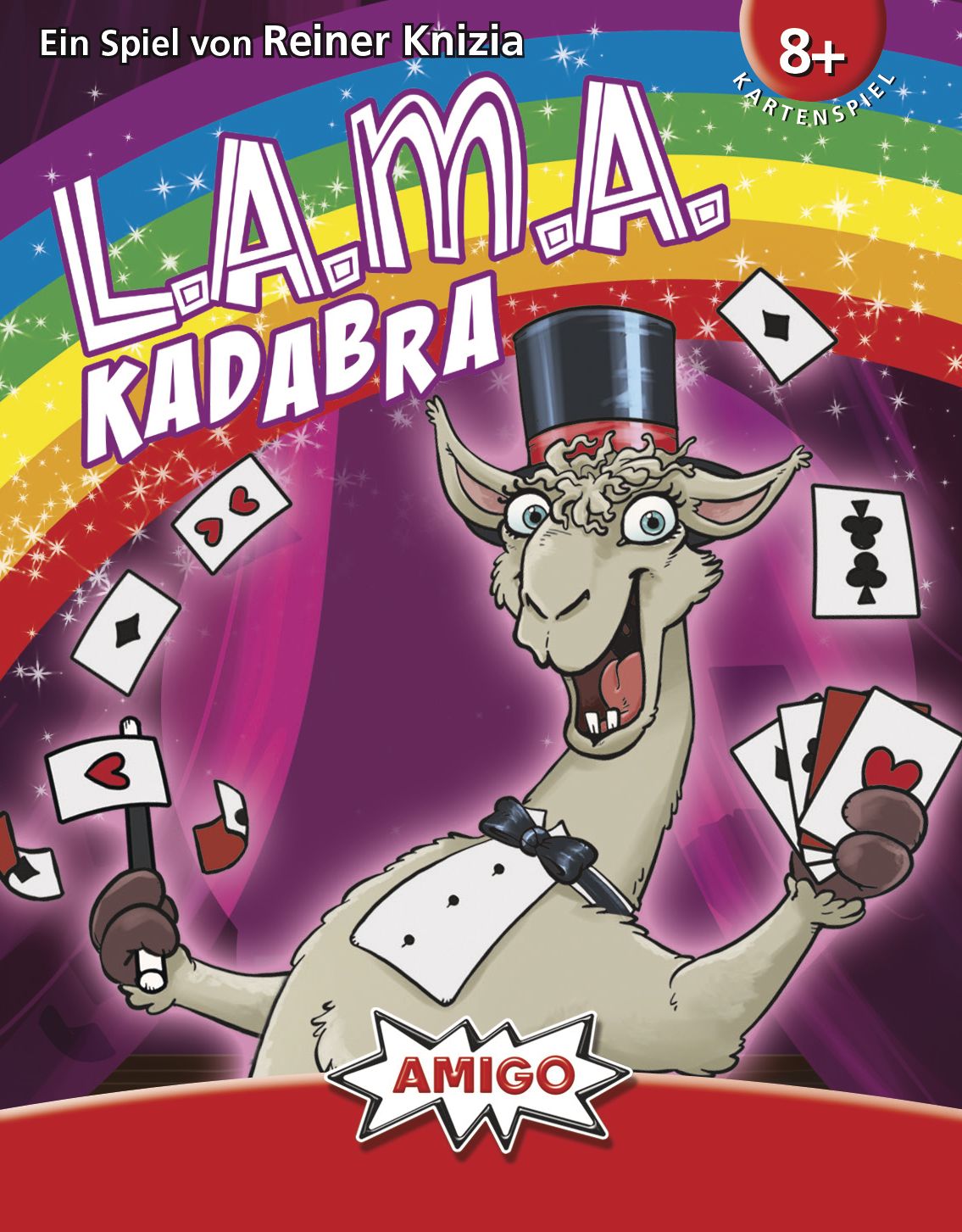
Llama kadabra

- Tipo
- Juego de Mesa
- Empresa Desarrolladora
- AMIGO
- Publicado por
- Fractal Juegos
- Sitio Web
- fractaljuegos.com/juegos/llama-kadabra
- Año Publicación Chile
- 2024
- País de fabricación
- China
- Ediciones
- 1
- País de Origen
- Alemania
- URL BGG
- Ver en BoardGameGeek
- Año Publicación (BGG)
- 2024
- MIN # Jug. (BGG)
- 2
- MAX # Jug. (BGG)
- 6
- Tiempo de Juego
- 20
- Edad Recom. (BGG)
- 8
- Peso (1-5) (BGG)
- 1,5
- Descripción del Juego (ING)
The card game L.A.M.A. Kadabra plays similarly to the 2019 game L.L.A.M.A., but with a few additions that complicate gameplay and your choices of what to do.
Let's start with the basics of L.L.A.M.A.: Each player starts a round with six cards in hand; the deck consists of llama cards and cards numbered 1-6. On a turn, the active player can play a card, draw a card, or quit. To play a card, you must play the same number as the top card of the discard pile or one number higher. If a 6 is on top, you can play a 6 or a llama, and if a llama is on top, you can play another llama or a 1. If you quit, you place your remaining cards face down and take no further actions. If all players have quit but one, that player can continue to play, but cannot draw more cards.
The round ends when one player empties their hand or all players have quit. In either case, players collect chips based on the cards in their hand. Each different number card in hand gets you white chips (each worth 1 point) equal to the value of the card while one or more llamas gets you a black chip (worth 10 points). (You can exchange ten white chips for one black chip at any time.) If you played all your cards, you can return one chip (white or black) that you previously collected to the supply. You then shuffle all the cards and begin a new round, in which the first player to play will be the one who emptied their hand or was the last one to quit in the previous round.
L.A.M.A. Kadabra adds four new elements to the gameplay described above:
• Double cards: Some cards show two numbers: 2/3 and 4/5. You can play a 2/3 on a 1, a 2, or a 3, so they give you more flexibility, but if you end the round with one in hand, it counts as both numbers when you're collecting chips.
• Action cards: When you play a 1, give one of your lowest chips — yes, including a black chip if that's all you have — to any player who hasn't yet quit. When you play a card with a rectangle on it, the next player to take a turn must draw a card, then take their turn as normal.
• The magic chip: When you play a card with a star, claim the lone blue magic chip from whoever currently holds it. On a future turn, you can discard the chip to skip your turn. If you hold this chip (and no white ones) when you play a 1, give this to another player. If you hold the magic chip at the end of the round, it's worth 10 points.
• The magic show: Whenever you play a llama, place one of your lowest chips on the magic stage. When the magic stage has at least five chips on it, the magic show begins. During a magic show, if you play a llama, place one of your lowest chips on the magic stage; if you can't or don't want to play a llama, take all of the chips on stage to end the magic show, then take your turn as normal.
The game ends at the end of the round where at least one player has forty or more total points. Whoever has the fewest points wins.
- Diseño Chileno
- No
- Autores/as
- Reiner Knizia
- Arte Chileno
- No
- Ilustradores/as
- Rey Sommerkamp, Barbara Spelger
- Origen
- Localización
- Categoría de Público
- Familiar / Filler
- Disponible Internacionalmente
- No
- Internacionalizado
- No
- Fondos Concursables
- No
- Premios
- No
- Fecha de Actualización
- Agosto 15, 2026
Algunos datos provienen de  .